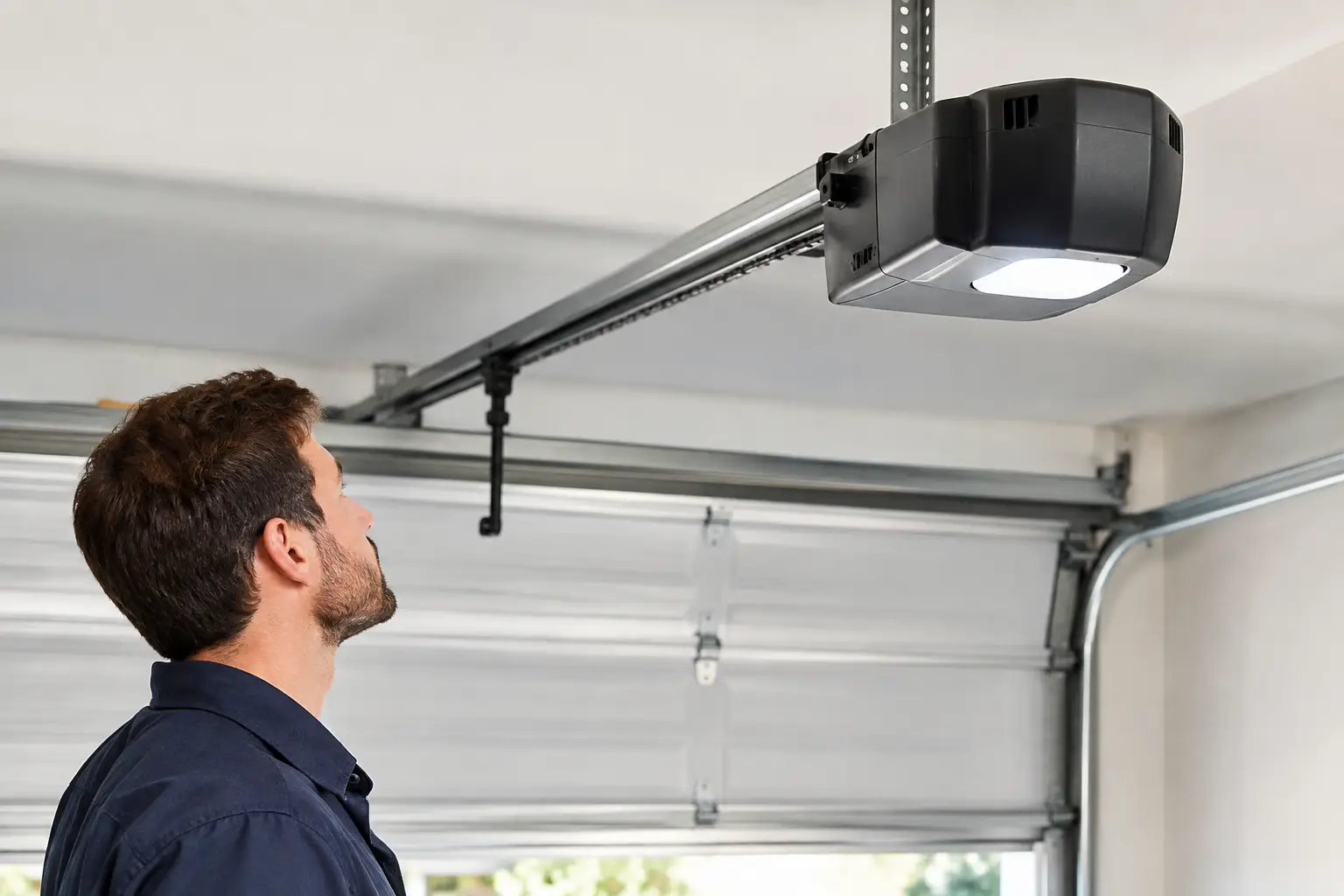
A garage door opener does not have to hang from the middle of your ceiling. That is the appeal behind a jackshaft garage door opener. In this jackshaft garage door opener review, we break down where this side-mounted system shines, where it can cost more, and whether it is the right fit for your garage.
For many homeowners, the decision starts with one practical problem: a traditional opener rail is in the way. Maybe you want overhead storage, a car lift, taller vehicles, or a cleaner-looking garage. A jackshaft opener moves the motor to the wall beside the garage door, giving the ceiling back to you. It is a smart upgrade in the right setup, but it is not automatically the best choice for every door.
What Is a Jackshaft Garage Door Opener?
A jackshaft garage door opener mounts on the wall next to the garage door and turns the torsion bar directly. Instead of using a ceiling-mounted motor, long rail, chain, belt, or screw drive, it operates from the side of the door opening.
Most residential jackshaft systems include safety sensors near the floor, a wall control, remote controls, and a cable tension monitor. Better-equipped models may add battery backup, app control, automatic locking, and built-in lighting. Because the opener is mounted beside the door, lighting may need to be planned separately if your garage depends on the bulb in a traditional ceiling-mounted opener.
This design is often called a wall-mount opener. It is especially popular with high-lift doors, garages with cathedral or obstructed ceilings, and homeowners who want more usable overhead space.
Jackshaft Garage Door Opener Review: The Real Advantages
The biggest benefit is ceiling clearance. With no center rail running from the door to the back wall, you have room for storage racks, overhead shelving, bikes, kayaks, or a vehicle lift. For a garage that doubles as a workshop, gym, or storage area, that extra space can make a noticeable difference every day.
Jackshaft units can also be quieter than many older chain-drive openers. The motor is mounted at the side instead of directly overhead, and there is no long rail vibrating across the ceiling. You will still hear the rollers, hinges, springs, and door sections moving. If the door itself is noisy, replacing the opener alone will not make it whisper-quiet. But on a well-maintained door, a quality wall-mount unit generally delivers a more refined operating sound.
The security features are another strong point. Many models use an automatic deadbolt that engages when the door closes. That can provide more security than relying on the opener motor alone to hold the door shut. Smart controls also allow you to check whether the door is open and close it from your phone, which is useful when you are already at work or away for the weekend.
For Arizona homeowners, battery backup deserves special attention. Power outages can happen during monsoon storms, and a battery backup lets you operate the door when the power is out. It is a convenience feature until you need it, then it becomes a very practical one.
Where a Wall-Mount Opener Falls Short
The primary drawback is price. A jackshaft opener usually costs more than a standard belt-drive opener, and installation can be more involved. The unit itself is only part of the budget. Your garage door must have the right torsion spring setup, adequate side clearance, a properly supported torsion tube, and safe, balanced operation.
This is not a product that should be used to compensate for a struggling garage door. If the door is heavy, crooked, jerky, or difficult to lift by hand, the springs, cables, rollers, tracks, or bearings need attention first. Installing a new opener on an unbalanced door can wear out the opener early and create a safety issue.
Lighting is the other trade-off. Traditional openers often place lights near the center of the garage. A jackshaft unit is mounted to one side, so its built-in light may not brighten the entire space. Homeowners with a dark garage may want separate LED shop lights or a ceiling light fixture.
Finally, not every garage has the room. The torsion bar needs enough clear wall space beside the door, and the opener must be mounted where it will not interfere with shelving, a side door, plumbing, electrical panels, or other equipment. A professional measurement before purchase can prevent an expensive mismatch.
Is Your Garage a Good Candidate?
A jackshaft opener works best when the garage door uses torsion springs mounted above the opening. Many modern sectional doors do, but assumptions can lead to trouble. Extension spring systems, unusual door configurations, low-clearance hardware, and certain commercial doors may need different solutions.
Your door should also be in good mechanical condition. With the opener disconnected, a balanced door should lift smoothly and stay near the halfway point without racing up or dropping down. Do not test or adjust springs yourself. Garage door springs are under extreme tension and should be serviced by a trained technician.
A wall-mount opener is often a particularly good fit for these situations:
- You need open ceiling space for storage, a lift, or tall equipment.
- Your garage has a high ceiling, sloped ceiling, or overhead obstruction.
- You want automatic locking and smart-home features.
- You are replacing an aging opener and your existing door hardware is in good shape.
If your only goal is a dependable opener at the lowest upfront cost, a standard belt-drive model may be the better value. It can be quiet, reliable, and more affordable when ceiling space is not a concern.
Performance Depends on the Door, Not Just the Opener
A common mistake is shopping by horsepower or feature list alone. A properly sized opener paired with a balanced, well-maintained door will outperform an oversized opener connected to worn hardware.
Before installation, the technician should inspect spring tension, cables, drums, rollers, bearings, tracks, hinges, and the torsion tube. This matters even more with a jackshaft unit because it turns the torsion tube directly. A bent tube, worn bearing, loose cable drum, or damaged spring can affect operation and put extra strain on the system.
For insulated steel residential doors, a quality residential wall-mount opener is typically plenty capable when the door is balanced. Heavier custom wood doors and oversized doors may require a more specialized recommendation. Commercial settings also need a separate evaluation because cycle volume, door weight, and security demands are different.
Features Worth Paying For
Not every upgrade is essential, but a few features bring real day-to-day value. Battery backup is a strong choice for households that rely on the garage as a primary entry. Wi-Fi control is helpful for checking the door status, receiving alerts, and letting in a family member or delivery without sharing a remote.
An automatic deadbolt is worth considering if security is a top priority. Soft start and stop operation can reduce abrupt movement, although it will not correct a noisy door with worn rollers or loose hardware. Motion-activated lighting is convenient, but remember that the location of the light matters in a side-mounted design.
Ask about the warranty, what labor is covered, and whether the quoted price includes removal of the old opener, programming remotes, safety sensor alignment, and any needed electrical work. Transparent pricing should explain the complete job, not leave you guessing what will be added after installation begins.
Installation Is Not the Place to Cut Corners
Jackshaft opener installation requires precise mounting and correct setup of safety systems. The cable tension monitor, photo-eye sensors, travel limits, and force settings all need to work properly. An opener that closes inconsistently, reverses unexpectedly, or leaves slack in a cable needs prompt attention.
Arizona heat can also be hard on garage components over time. Plastic parts, remotes left in vehicles, batteries, and weather seals all deserve periodic checks. Keeping the door lubricated, testing the safety reversal system, and scheduling a professional checkup can help protect the investment you make in a new opener.
The Bottom Line for Homeowners
Our honest take is that a jackshaft opener is an excellent upgrade when ceiling space, clean design, smart controls, and security matter to you. It is not the cheapest route, and it needs the right door setup, but it solves problems that a conventional opener simply cannot solve.
Before choosing one, have the door and garage layout inspected so you know whether it is a true fit rather than an expensive guess. If you are in Gilbert, Mesa, Chandler, or nearby and want clear answers without surprises, Riggs Rescue AZ can evaluate your door, explain the options, and help you choose an opener that works for your home long after installation day.

Leave a Reply