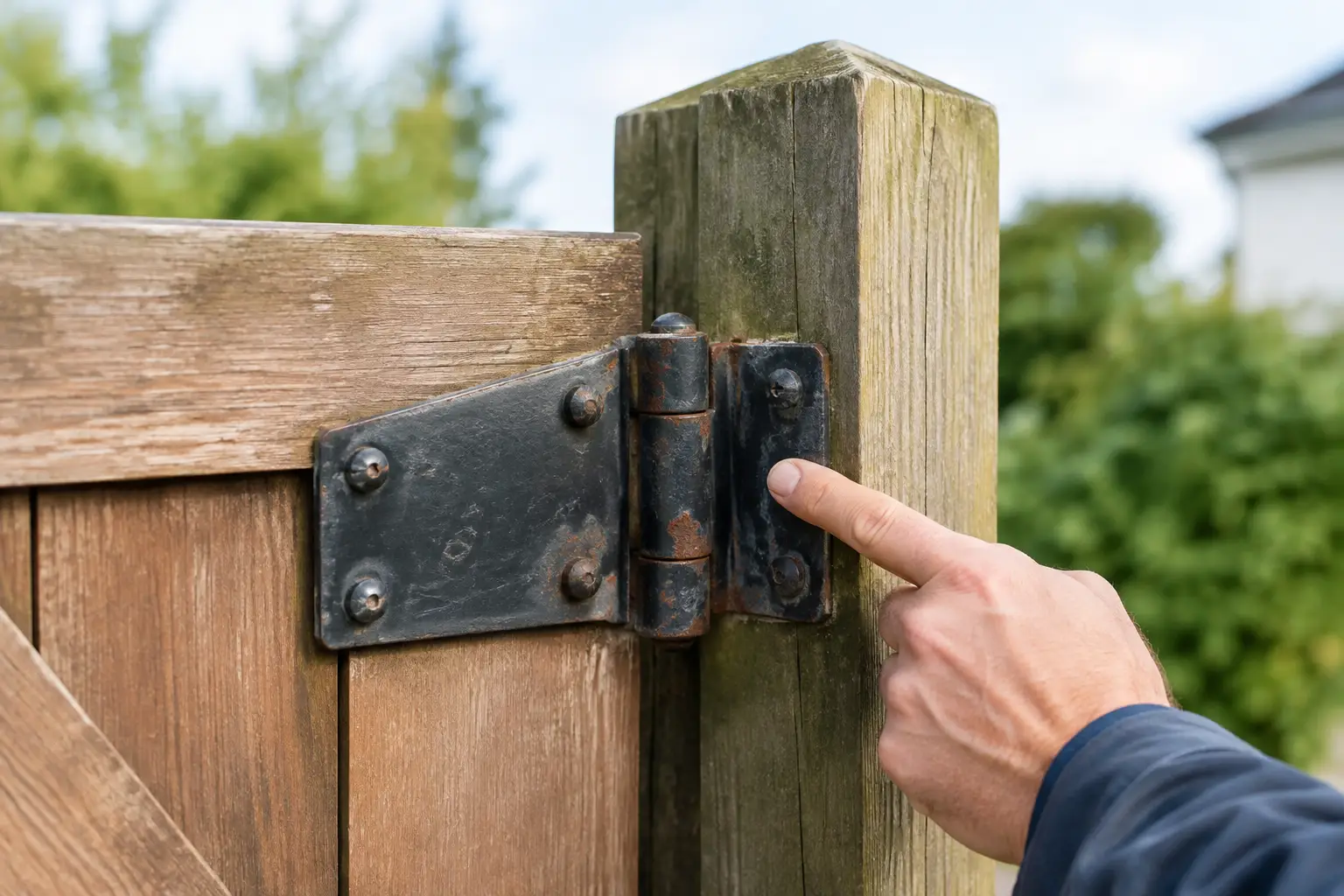
A gate that suddenly drags across the driveway, refuses to latch, or makes a sharp scraping sound usually did not develop the problem overnight. In many cases, the warning signs were hiding in the hinges. Knowing how to spot worn gate hinges can help you address a small repair before it turns into a stuck gate, damaged operator, or security concern.
For homeowners and business owners, hinges can be easy to overlook because they work quietly in the background. But in Arizona, heat, dust, wind, frequent use, and heavy gate panels all put pressure on these moving parts. A quick visual check and a little attention to how your gate moves can tell you a lot.
How to Spot Worn Gate Hinges During a Basic Check
Start with the gate closed, then open and close it slowly while watching the hinge side. You are looking for movement that seems uneven, noisy, loose, or forced. A healthy hinge should support the gate’s weight while allowing it to swing in a smooth, predictable path.
Do not try to force a gate that is badly stuck or hanging at an angle. If the gate is automatic, keep hands clear of the operator and moving components. A heavy gate can shift quickly, especially when a hinge, bracket, or post is failing.
The gate is sagging or sitting out of level
Sagging is one of the clearest signs of hinge wear. Look across the top rail of the gate when it is closed. If it slopes downward toward the latch side, one or more hinges may have worn pins, enlarged hinge barrels, loose mounting hardware, or damaged welds.
You may also notice that the latch no longer lines up with the receiver. A gate that once closed cleanly may need to be lifted, pushed, or pulled to latch. While a settling post or shifted gate frame can create similar symptoms, hinge wear is often part of the issue – especially on older, heavy, or frequently used gates.
You hear grinding, squeaking, popping, or metal-on-metal scraping
A little noise does not always mean a hinge needs replacement. Dry hinges often squeak and may simply need proper lubrication. Grinding, popping, or scraping is more concerning because it can mean the hinge pin is worn, the barrel is damaged, or the gate has shifted enough to rub against another surface.
Listen closely as the gate starts moving and again as it reaches the fully open and closed positions. Noise at one particular point can help a technician identify whether the problem is a hinge, latch alignment, ground clearance issue, or automatic gate operator setting.
The hinge moves when the gate moves
Hinges are supposed to pivot. Their mounting points are not supposed to move. With the gate closed and secured, inspect each hinge where it attaches to the post and gate frame. Look for bolts that appear loose, brackets pulling away from the frame, cracked welds, or visible gaps around mounting plates.
Rust-colored staining around a hinge can also be a clue that moisture has entered the connection or that metal is wearing against metal. Surface rust can often be managed early. Deep corrosion, flaking metal, or a hinge that looks thin and pitted may call for replacement rather than another adjustment.
The gate drops when you lift it gently
Without putting yourself under the gate or using excessive force, carefully check for vertical play. If you can lift the latch side of a closed gate and it rises noticeably before the hinges engage, the pins or barrels may be worn.
This is especially common with large driveway gates and pedestrian gates that get slammed or used throughout the day. The extra movement allows the gate to settle lower over time, placing added stress on the latch, operator arm, rollers, and frame.
Check for Uneven Gaps and Dragging
The space around a gate should look reasonably consistent. Check the gap between the gate and the post, the gate and the ground, and the two leaves of a double gate. A changing gap is not always a hinge issue, but it is a reason to investigate.
If the gate drags on concrete, gravel, pavers, or a threshold, do not assume the ground is the only problem. A worn top hinge can allow the gate to lean outward, while a worn bottom hinge can let it drop. Either condition can make the gate scrape the ground and become harder to operate.
For automatic gates, dragging creates another problem: the opener has to work harder. That added resistance can strain the motor, arm, chain, or control components. A hinge repair can sometimes prevent a much more expensive automatic gate repair later.
Watch What Happens at the Latch
The latch is often where hinge wear becomes impossible to ignore. When hinges are supporting the gate correctly, the latch should meet its catch without being lifted, shoved, or held in place.
A gate that bounces off the latch, closes too low, or only latches when someone pushes on it may be out of alignment. Check whether the latch itself is loose, but also look back to the hinges. Adjusting a latch without correcting a sagging gate may provide only a temporary fix.
For a commercial property, a gate that does not latch properly can affect security, employee access, deliveries, and daily operations. For a home, it can leave a side yard, pool area, or driveway less secure than it should be.
When Lubrication Helps and When It Does Not
Lubrication is useful preventive maintenance, but it is not a cure for every hinge problem. If the hinges are clean, structurally sound, and only squeaking, a gate-safe lubricant may restore quieter movement. Wipe away dust and old buildup first, then use a product appropriate for exterior metal hinges.
Avoid coating hinges with heavy grease that attracts more Arizona dust and grit. Also avoid spraying lubricant near an automatic gate’s electrical components, photo eyes, control box, or operator motor.
Lubrication will not fix worn hinge pins, cracked welds, loose bolts, bent brackets, severe corrosion, or a gate that has become too heavy for its hardware. If the sound returns quickly after lubrication, there is likely a deeper cause worth checking.
Why Worn Hinges Should Not Be Put Off
A worn hinge can seem like a minor annoyance until the gate binds, drags, or stops closing altogether. As alignment gets worse, the gate can damage its latch, strike post, decorative panels, paving, and automatic opener. In more serious cases, a failing hinge can allow a gate panel to shift unexpectedly.
The right repair depends on the condition of the gate and how it is built. Some gates need new hinge pins or bushings. Others need hinges rewelded, mounting hardware replaced, a post repaired, or the entire hinge assembly upgraded to better support the gate’s weight. A professional inspection can separate a straightforward adjustment from a structural concern.
When to Call for Gate Hinge Repair
Call for service promptly if the gate is visibly sagging, dragging, difficult to latch, making grinding sounds, or moving at the hinge mounts. You should also schedule an inspection if an automatic gate begins reversing, straining, stopping mid-cycle, or requiring more force than usual to open manually.
Do not attempt to remove a hinge pin from a large gate without proper support and equipment. Gate panels are heavier than they look, and removing the wrong component can create a real injury risk or damage the operator system.
For property owners in Gilbert, Chandler, Mesa, Queen Creek, and nearby East Valley communities, Riggs Rescue AZ can inspect the full gate system, explain what is causing the problem, and recommend a practical repair with no surprises. Addressing worn hinges early keeps your gate easier to use, helps protect your access system, and gives you one less property problem waiting to become urgent.

Leave a Reply