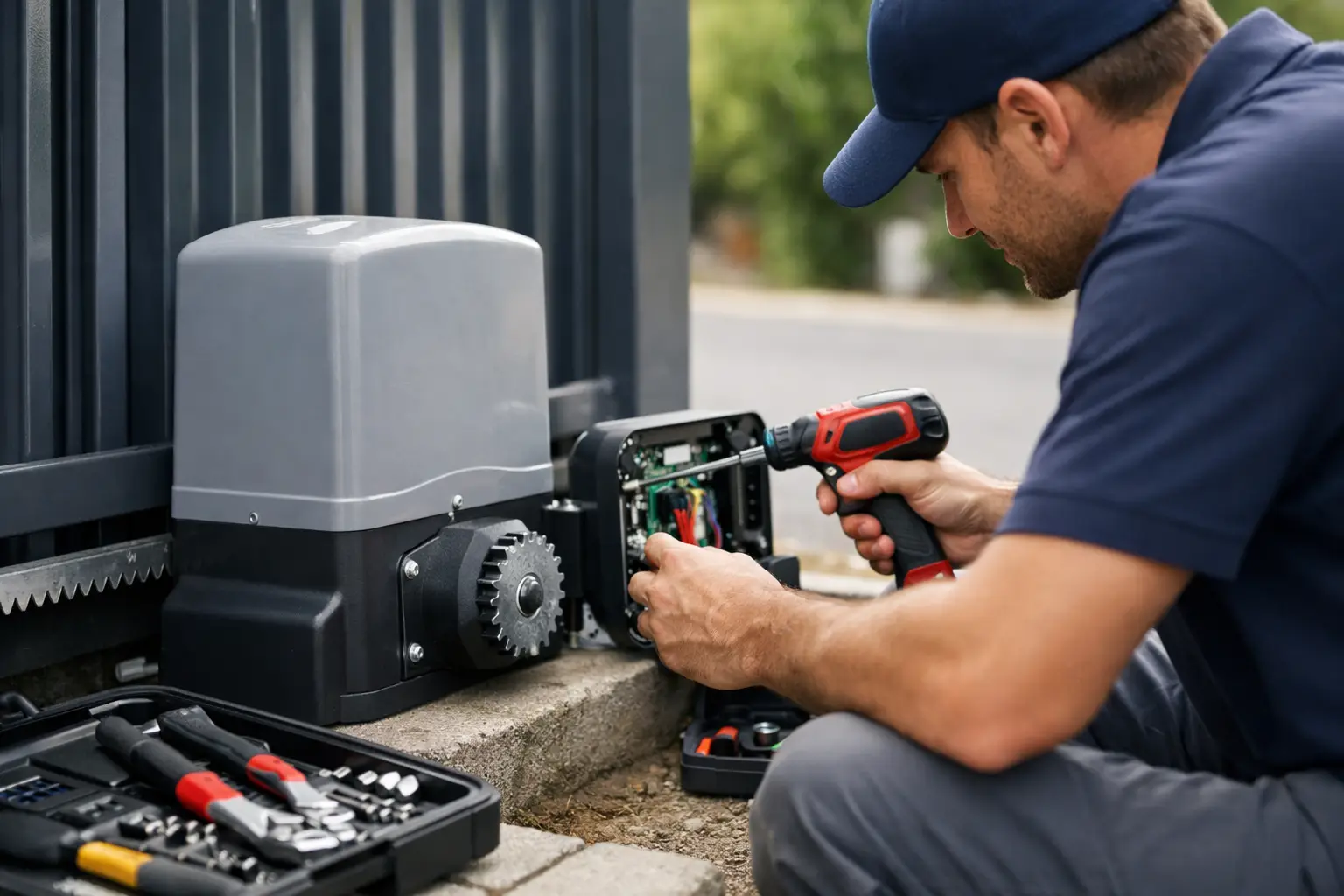
A gate that stops halfway on a hot Arizona afternoon is more than annoying. It can leave your home exposed, trap your car in the driveway, or slow down business traffic when you need things moving. This automatic gate repair guide is built for property owners who want clear answers, practical next steps, and no guesswork about when a problem is simple and when it calls for professional service.
What this automatic gate repair guide covers
Most automatic gate issues fall into a few categories: power problems, worn hardware, sensor trouble, remote or keypad failures, and opener or control board issues. The tricky part is that the symptom you notice is not always the real cause. A gate that will not open might have a dead remote battery, but it could also have a tripped breaker, a blocked photo eye, a failing motor capacitor, or a damaged track.
That is why the smartest approach is to start with safe, visible checks before assuming the opener is bad. In many cases, you can narrow the problem down in a few minutes and avoid replacing the wrong part.
Start with safety before you touch anything
Automatic gates are heavy, under tension, and connected to electrical components. That combination makes them very different from a loose fence latch or sticky front door. If the gate is off track, sagging, making grinding sounds, or moving unpredictably, do not force it. Disconnecting a gate opener without understanding the release system can also create problems if the leaf or slide section is already under strain.
A good rule is simple. If the issue involves exposed wiring, damaged hinges, a bent track, a failing motor, or anything that affects the gate’s weight and movement, stop there and schedule service. If the issue is clearly external, like a weak remote battery or debris blocking the path, a basic check is reasonable.
First checks that solve a surprising number of gate problems
Before getting into tools or parts, look at the basics. Is the opener getting power? Check the breaker, outlet, disconnect switch, and any visible transformer connection. If your system has a backup battery, see whether it is old, swollen, or unable to hold a charge.
Next, inspect the gate path. For a sliding gate, look for rocks, sticks, mud buildup, or anything packed into the track. For a swing gate, make sure there is nothing blocking the arc of travel. Even a small obstruction can trigger a stop or reverse feature.
Then test the access devices. Replace the remote battery, confirm the keypad has power, and make sure no settings were lost after a power outage. If multiple remotes fail at the same time, the issue is probably not the remotes themselves.
Gate opens, then stops or reverses
This is one of the most common service calls, and there are a few likely causes. Safety sensors may be misaligned or dirty. Many systems are designed to reverse if they sense resistance, which protects people, pets, and vehicles but can also create nuisance problems when sensors are dusty or hardware is wearing out.
A sliding gate may also reverse if the rollers are binding or the track is uneven. A swing gate can do the same if the hinges are sagging or the arm geometry is off. Heat expansion, rust, and normal wear all play a part over time.
You can clean photo eyes and remove visible debris, but if the gate still hesitates or changes direction, it is time for a closer mechanical inspection. Repeated reversing is not something to ignore. It usually gets worse, not better.
Gate moves slowly or sounds rough
A slow gate is often an early warning sign. The opener may still work, but it is working harder than it should. That extra strain can shorten the life of the motor, gears, chain, or arm assembly.
On a swing gate, check for hinge wear, rust, and signs the gate is dragging. On a slide gate, look at rollers, chain tension, and track condition. Dry or dirty moving parts can create resistance, but over-lubricating the wrong area can also attract grit and cause buildup. It depends on the gate type and manufacturer specs, which is why random spray-on fixes are not always helpful.
If you hear grinding, popping, or metal-on-metal contact, skip the trial-and-error. Those sounds usually point to worn hardware or alignment issues that need proper adjustment.
Remote works sometimes, keypad does not, or the gate seems inconsistent
Intermittent problems are frustrating because the gate seems fine until you are late for work or trying to close up for the night. Start by separating the access problem from the gate movement problem. If the gate runs normally from the wall control or board test button but not from the remote, focus on the transmitter, receiver, keypad, or programming.
Dead batteries are the easy fix. After that, signal interference, damaged wiring, water intrusion, and memory loss after a power event are all possible. Some older systems also have receivers that simply age out.
The trade-off here is cost versus reliability. Reprogramming a remote may restore function for now, but if the receiver or keypad is failing, a replacement often saves more time and frustration than repeated resets.
When the opener has power but nothing happens
If the unit has power and the gate still does not respond, there may be a problem with the control board, limit settings, capacitor, or motor. In some cases, safety loops or exit devices can also interrupt normal operation if they are damaged or stuck in an active state.
This is where DIY usually reaches its limit. Electrical diagnosis on gate systems is not just about finding voltage. It is about understanding how the board is reading commands, safety inputs, and limit positions. Replacing parts based on a guess can get expensive fast.
For homeowners and small business owners, the practical move is usually to document the symptom clearly. Does the unit hum? Click? Show indicator lights? Respond only after cooling down? Those details help speed up a proper repair.
Weather, dust, and Arizona wear
Local conditions matter more than many people realize. Dust can coat sensors and tracks. Heat can stress batteries, control boxes, and older wiring. Monsoon moisture can expose weak seals and create corrosion inside components that looked fine from the outside.
That means a gate problem is not always about age alone. A newer system can struggle if it was poorly installed, not maintained, or left exposed to preventable wear. The best repair is sometimes a small correction made early, before the opener burns itself out trying to overcome resistance.
Repair or replace? It depends on the system
Not every gate with recurring issues needs full replacement. If the frame is solid and the operator is from a supported brand, repair is often the most cost-effective choice. Replacing hinges, rollers, sensors, keypads, batteries, or a control board can make sense when the rest of the system is in good shape.
Replacement becomes more attractive when parts are obsolete, the gate is structurally compromised, or the opener has had repeated failures. Commercial properties may also choose replacement sooner if downtime affects deliveries, tenant access, or security.
The right answer depends on age, part availability, repair history, and how critical the gate is to daily use. Honest guidance matters here. You want a fix that lasts, not a temporary patch that turns into another service call next month.
When to call for professional gate repair
Call for service if the gate is stuck open or closed, comes off track, sags, trips the breaker, reverses repeatedly, or shows signs of opener failure. The same goes for damaged arms, chain problems, bent hardware, exposed wiring, and safety devices that are not working correctly.
If you manage a business or shared property, it is also smart to act early. A gate that still operates but hesitates, drags, or responds inconsistently is already warning you. Fast attention usually means a smaller repair, less downtime, and fewer surprises.
A dependable local company should be able to explain the issue in plain language, tell you whether repair or replacement makes more sense, and give you clear pricing before work begins. That is the standard at Riggs Rescue AZ, and it is the standard property owners should expect.
A simple maintenance habit that pays off
You do not need a complicated schedule to protect your gate. Just pay attention to changes. If it gets louder, slower, less responsive, or harder to close, do not wait for complete failure. A quick checkup can catch worn parts before they turn into a bigger repair.
The best closing thought for any automatic gate is this: a small problem rarely stays small when the system keeps cycling every day. Handle it early, and your gate has a much better chance of staying safe, reliable, and affordable to own.

Leave a Reply