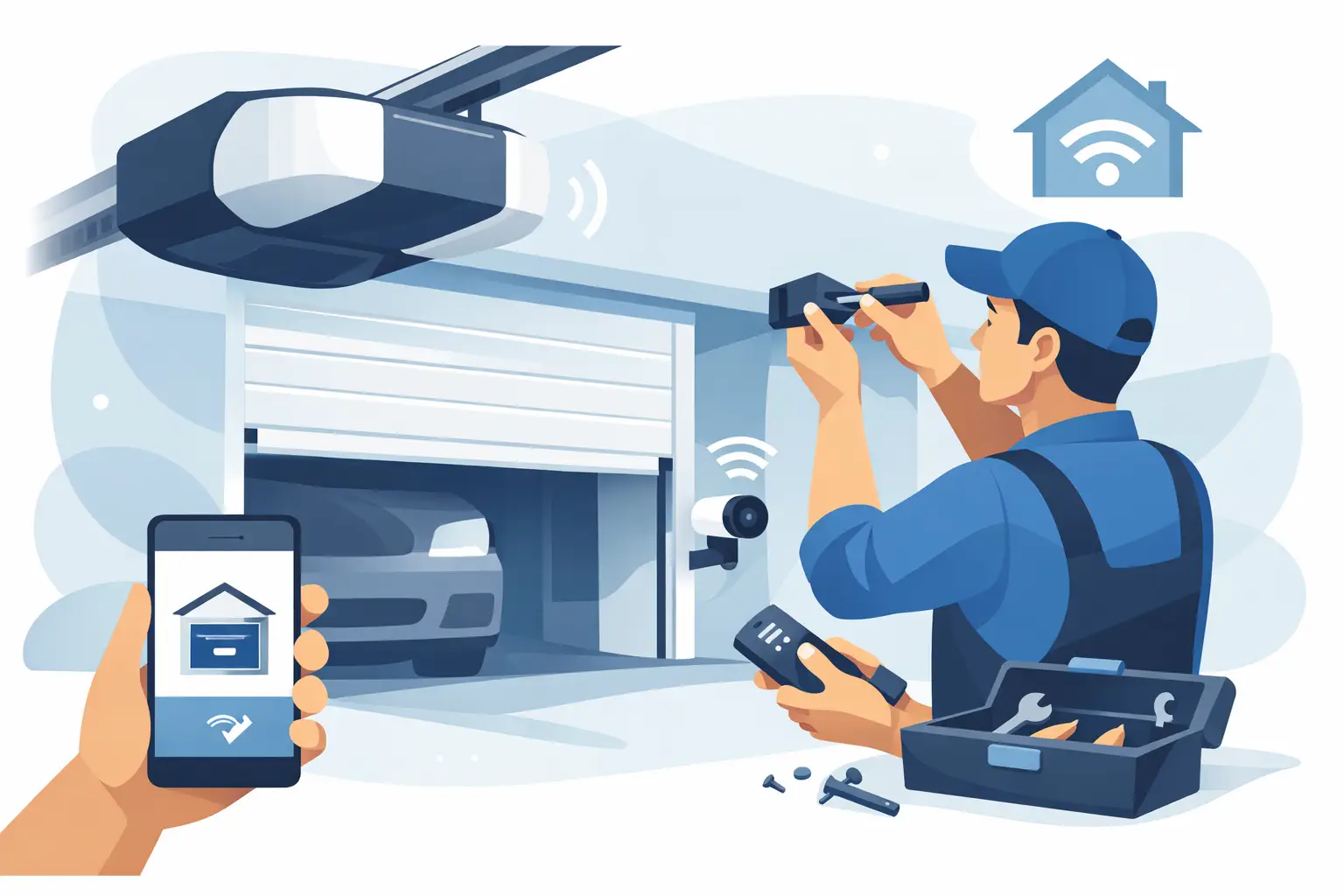
That moment when you are halfway to work and suddenly wonder, “Did I close the garage door?” is exactly why smart garage door opener installation has become such a popular upgrade for Arizona homes and small businesses. A good smart opener gives you remote control, real-time alerts, and one less daily worry. But the right setup matters, because convenience only helps if the system is reliable.
For many property owners in Gilbert, Chandler, Mesa, Queen Creek, San Tan Valley, and Phoenix, the goal is simple: open and close the door from a phone, check status from anywhere, and add a little more security without turning the garage into a science project. That is absolutely possible, but not every door, motor, and Wi-Fi setup is equally ready for the upgrade.
What smart garage door opener installation really includes
A lot of people assume a smart opener is just a motor with an app. In practice, smart garage door opener installation can mean a few different things depending on your current equipment. Sometimes it is a full opener replacement with built-in Wi-Fi and app controls. Other times, it is an add-on smart controller that connects to a compatible existing opener.
The difference matters. If your current opener is newer, in good shape, and has the right safety features, adding a smart module may be the most affordable route. If the opener is older, noisy, unreliable, or missing modern safety features, replacement often makes more sense than trying to upgrade around worn-out equipment.
A proper installation also looks beyond the opener itself. The door has to be balanced, the tracks should be in good condition, and the safety sensors need to be aligned and working correctly. If the mechanical side of the system is struggling, smart features will not fix that. They may just make the problem easier to notice from your phone.
Is your current system a good candidate?
This is where honest guidance matters. Some doors are great candidates for a fast upgrade. Others need a little work first.
If your garage door opens smoothly, closes evenly, and your opener responds consistently, you may be able to install a smart controller without replacing the entire unit. But if the motor strains, the door jerks, or the opener has random failures, the smarter move is usually a new system. You do not want to put new technology on top of old problems and hope for the best.
There is also the matter of compatibility. Some older opener brands and wall controls do not play well with newer smart systems. Certain models require special adapters. Some are simply not worth the trouble. That is one reason homeowners often end up frustrated after trying to order a device online that looked simple in the product description but does not match what is actually hanging from their ceiling.
Wi-Fi strength is another factor people overlook. If the garage is at the far end of the house or separated by block walls, the opener may connect poorly or drop offline. In Arizona homes, that happens more often than you might think. A professional installation can help identify whether the issue is the opener, the controller, or the signal itself.
The biggest benefits of a smart opener
The obvious benefit is remote access. If a family member gets home early, if a delivery needs to be placed inside, or if you leave town and want to double-check the door status, that control is useful right away. For busy households, it is not just a nice feature. It saves time and avoids those second-guessing moments.
Security is the other major advantage. Smart openers can send alerts when the door opens or closes, show whether it is currently open, and sometimes let you create scheduled closing times. That matters for homeowners, and it also matters for small businesses that use garage access for storage, inventory, or service vehicles.
There is also a practical maintenance angle. Some smart systems can alert you when the opener is acting up or when repeated attempts to close the door fail. That does not replace an inspection, but it can give you an earlier warning before a small issue becomes an urgent repair.
Smart garage door opener installation is not always DIY-friendly
Some installations are straightforward. Others are not. If you are adding a smart controller to a compatible, newer opener and the instructions match your exact setup, a handy homeowner may be able to handle it. But full opener replacement is a different story, and even smaller smart upgrades can get messy fast when compatibility is unclear.
The biggest risk is not just wiring. It is missing the larger system issues. Garage doors are heavy, tension-driven systems. If the springs, rollers, sensors, or travel limits are off, a smart opener will not solve the root problem. Poor setup can also create safety issues, especially if the auto-reverse function is not tested correctly.
There is also the frustration factor. A project that looks like a one-hour install can turn into a weekend of pairing issues, app setup problems, sensor errors, and repeat ladder trips. For many homeowners, that is the point where professional installation starts to look like the more affordable option after all.
What a professional install should cover
A solid installation should start with the basics: the condition of the door, opener, rails, and safety components. If the door is not balanced, that should be addressed before or during the upgrade. Installing smart technology on an unstable door is asking for callbacks.
From there, the opener or smart controller should be mounted and connected correctly, the travel and force settings should be adjusted, the sensors should be tested, and the app should be paired and verified. The final step is just as important as the first. You should know how to use the system, how to receive alerts, and what to do if the opener goes offline.
For local customers, this is where working with a service company that understands both traditional garage door systems and modern opener technology makes a real difference. A team like Riggs Rescue AZ can look at the whole system, give clear recommendations, and help you avoid paying for upgrades that do not fit your door or your budget.
Choosing the right opener for your property
Not every customer needs the same setup. A single-family home with one main garage door has different needs than a small business with higher daily cycles and a stronger focus on access control.
For residential use, most people care about quiet operation, dependable app access, battery backup, and easy sharing with family members. Belt-drive openers are often a good fit because they run more quietly than chain-drive models. If there is a bedroom above the garage, that matters even more.
For commercial or light commercial use, durability and cycle performance matter more. The opener has to keep up with repeated use, and reliability becomes a business issue, not just a convenience issue. In those cases, a smart feature package is useful, but the opener still needs to be matched to the actual workload.
Battery backup is worth a close look in Arizona. Power outages may not happen every week, but when they do, having a way to operate the garage without hassle can save a lot of stress. It is one of those features people appreciate most after they need it.
Common problems after installation
Even a quality product can have issues if the setup is rushed. A door that does not fully close in the app, delayed notifications, Wi-Fi disconnects, and sensor errors are some of the most common complaints.
Sometimes the fix is simple, like improving Wi-Fi coverage or updating app settings. Other times, the issue traces back to poor alignment, incorrect programming, or an opener that was never a good match for the door. This is why the cheapest install is not always the cheapest result.
If your new smart opener works one day and acts up the next, do not ignore it. A garage door system usually gives warning signs before a larger failure. Catching those signs early can prevent an emergency repair and keep the opener from putting extra wear on the door.
When it makes sense to upgrade now
If your opener is more than 10 to 15 years old, lacks modern safety features, or has started becoming unreliable, this is usually the right time to consider an upgrade. The same goes for households that share access between multiple drivers, families with frequent deliveries, and business owners who want better visibility over entry points.
There is also a quality-of-life side to this. Some home upgrades are easy to postpone because they do not change much day to day. Smart garage access is different. When it is installed correctly, you use the benefit constantly.
A smart opener should make your life easier, not add one more thing to troubleshoot. The best results come from choosing a system that fits the door, the property, and the way you actually use the garage. If you want it done fast, reliably, and with no surprises, getting the setup checked by a local pro is often the easiest path forward.
A garage door is one of the hardest-working systems on your property. Giving it smarter control is a good move, as long as the installation is every bit as dependable as the door needs to be.

Leave a Reply