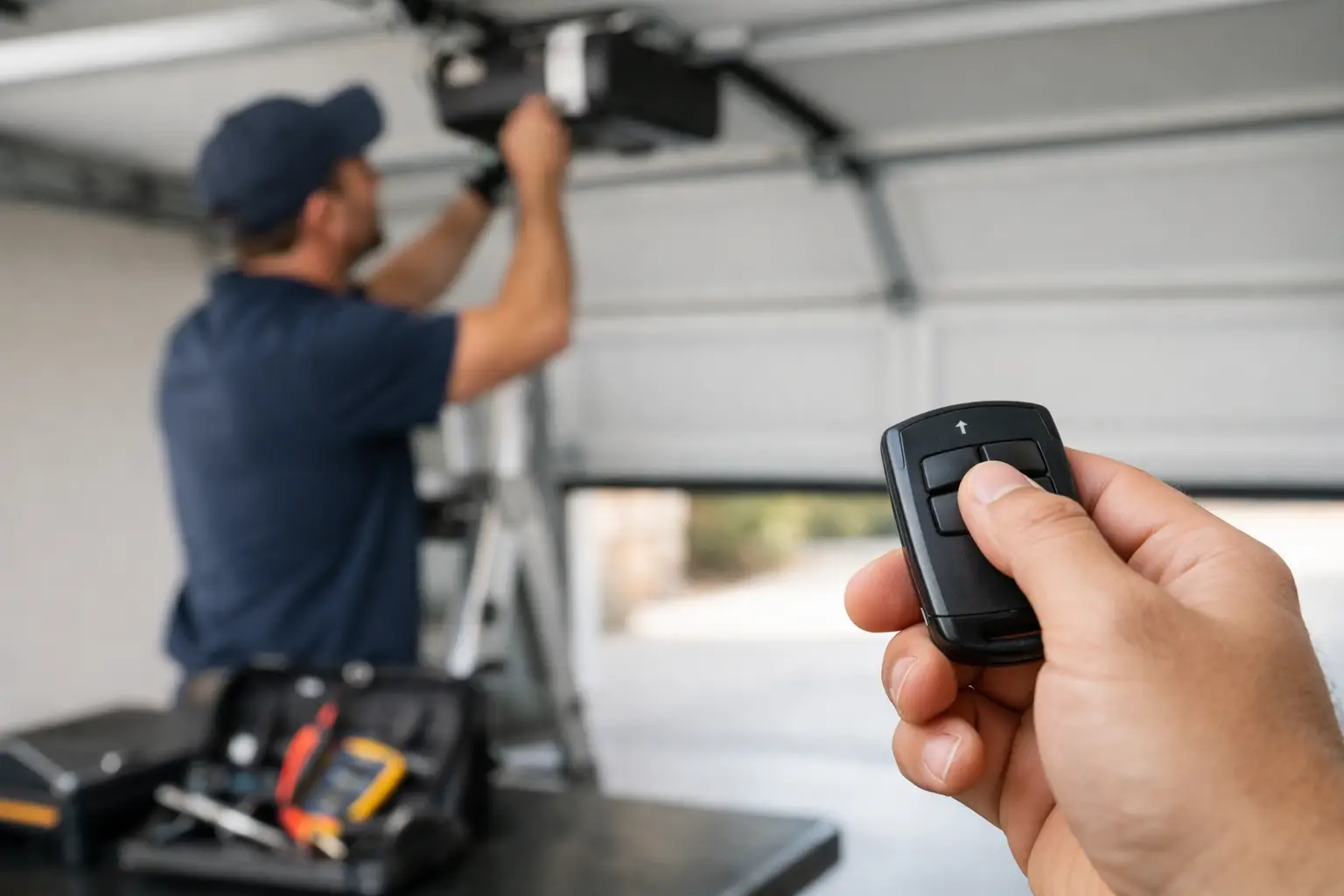
A garage door remote usually fails at the most inconvenient moment: when you are pulling into the driveway with groceries, trying to leave for work, or arriving at your business after hours. The good news is that learning how to fix garage door remote problems often starts with a few simple checks. The key is figuring out whether the remote is actually the issue or whether the opener, door, or safety system needs attention.
Before you take apart anything, make sure the garage door is fully closed or in a stable position. Never work near springs, cables, rollers, or a moving door. Those components are under serious tension and should be handled by a trained garage door technician.
How to Fix Garage Door Remote Issues Step by Step
Start with the quickest, least expensive possibilities. A weak battery, an accidental lock setting, or a lost connection between the remote and opener can look like a major breakdown when it is not.
Replace the remote battery first
A dead or weak battery is the most common reason a garage door remote stops working. If the remote has an LED light, press a button and watch for a dim light, flickering light, or no light at all. Those are good signs that the battery needs replacement.
Open the battery compartment and use the same battery type listed inside the remote or in its manual. Common options include coin-style batteries and small 9-volt batteries. Install the new battery with the positive and negative sides facing the correct direction, then test the remote from a few feet away from the door.
Do not assume a new battery is good simply because it is new. Batteries stored in a hot car or garage can lose power, which is especially relevant during Arizona summers. If the remote still does not work, try another fresh battery before moving to the next step.
Check whether the opener has power
If your remote does not work and neither does the wall-mounted control button inside the garage, the issue may not be the remote at all. Check whether the opener unit is plugged into its outlet and whether the outlet has power. A tripped GFCI outlet, breaker, or unplugged power cord can shut down the entire system.
If the opener light comes on but the motor will not respond, look for flashing lights or beeps. Many modern openers use these signals to point to a safety sensor, travel-limit, or internal opener problem. The pattern varies by manufacturer, so avoid guessing if the door is acting unpredictably.
Test the wall button and a second remote
Testing another control helps narrow down the source of the trouble. If the wall button works but your remote does not, the opener itself is likely receiving power and the remote may need a battery, reprogramming, or replacement.
If one remote works while another does not, focus on the nonworking remote. If none of the remotes work but the wall button does, the opener may have lost its programmed remotes or may be dealing with radio interference.
This quick comparison can save time and prevent you from replacing a remote when the actual problem is elsewhere.
Make sure vacation lock mode is not on
Many wall controls have a lock or vacation feature that disables wireless remotes for security. It is useful when you are away, but it can be activated by accident. The wall button may still operate the door normally while every handheld remote stops working.
Look for a button marked “Lock,” “Vacation,” or a padlock symbol on the wall control. On many models, pressing and holding that button for a few seconds turns the feature off. Check your opener instructions if you are unsure, since button functions differ by model.
Move closer and look for interference
A remote that works only when you are very close to the garage may have a range problem. Start by standing near the door and trying again. If it works up close but not from the driveway, inspect the remote battery and antenna on the opener.
The opener antenna is usually a short wire hanging from the motor unit. It should hang straight down and should not be cut, tucked behind metal, or wrapped around another wire. Avoid adjusting internal opener wiring yourself.
Radio interference can also reduce remote range. LED bulbs in or near the opener are a surprisingly common cause. Some low-quality LED bulbs give off interference that blocks the remote signal. Try removing the bulb temporarily and test the remote again. If the range improves, install a garage-door-opener-compatible LED bulb.
Other possible sources include wireless devices, charging equipment, security cameras, and damaged electrical components. Interference can be difficult to identify, so persistent range issues are a good reason to schedule service rather than keep replacing remotes.
Reprogram a Garage Door Remote
If the battery is fresh, the opener has power, and the remote still will not respond, it may have lost its connection to the opener. This can happen after a power outage, battery change, opener repair, or an accidental press of the opener’s learn button.
Most openers have a “Learn,” “Program,” or “Smart” button on the motor unit. It is often located behind the light cover, near the antenna wire, or on the back panel. Press the learn button once, then press the desired button on your remote within the time window specified for your opener. The opener light may flash or click to confirm programming.
Be careful not to hold the learn button down for too long. On many models, holding it can erase all programmed remotes and keypads. That is not dangerous, but it can create more work if several household members, tenants, or employees use different controls.
If your opener is older, the programming process may involve DIP switches rather than a learn button. In that case, the switch positions on the remote must match the opener or receiver exactly. If you are not comfortable identifying the correct system, a technician can set it up without risking a lost programming code.
When the Problem Is the Door, Not the Remote
A remote can be working perfectly while the garage door refuses to move because the door itself has a mechanical issue. This distinction matters. Forcing an opener to lift a damaged or heavy door can turn a manageable repair into an opener replacement.
With the door closed, look for obvious signs such as a crooked door, loose cable, bent track, broken roller, or a gap in the torsion spring above the door. Do not touch the springs or cables. A broken spring is one of the most common reasons a door will not open, and it requires professional repair.
Also check the photo-eye safety sensors near the bottom of each track. If their lenses are dirty, blocked, or out of alignment, the door may refuse to close or may reverse immediately after starting down. Wipe the lenses with a soft cloth and remove boxes, tools, or debris from their path. If one sensor light is off or blinking, alignment may be needed.
Signs You Should Call a Garage Door Professional
A new battery and simple reprogramming are reasonable homeowner fixes. Stop troubleshooting and call for help if the opener hums without moving the door, the door is crooked, a cable is loose, a spring appears broken, or the opener repeatedly reverses for no clear reason.
It is also smart to bring in a professional when remotes keep losing programming, the range suddenly drops throughout the property, or the opener is more than 10 to 15 years old. Sometimes the most affordable fix is a compatible replacement remote or receiver. Other times, an aging opener has reached the point where replacing it provides better reliability, quieter operation, and updated safety features.
For homeowners and small businesses in Gilbert, Mesa, Chandler, Queen Creek, and nearby East Valley communities, Riggs Rescue AZ can inspect the remote, opener, sensors, and door as one system. You get clear answers before work begins, with no surprises and no residential service or trip charge.
A garage door remote should make coming home or opening up for the day easier, not add another problem to your schedule. If the simple checks do not bring it back to life, getting a fast, honest diagnosis is the safest way to get dependable access again.

Leave a Reply