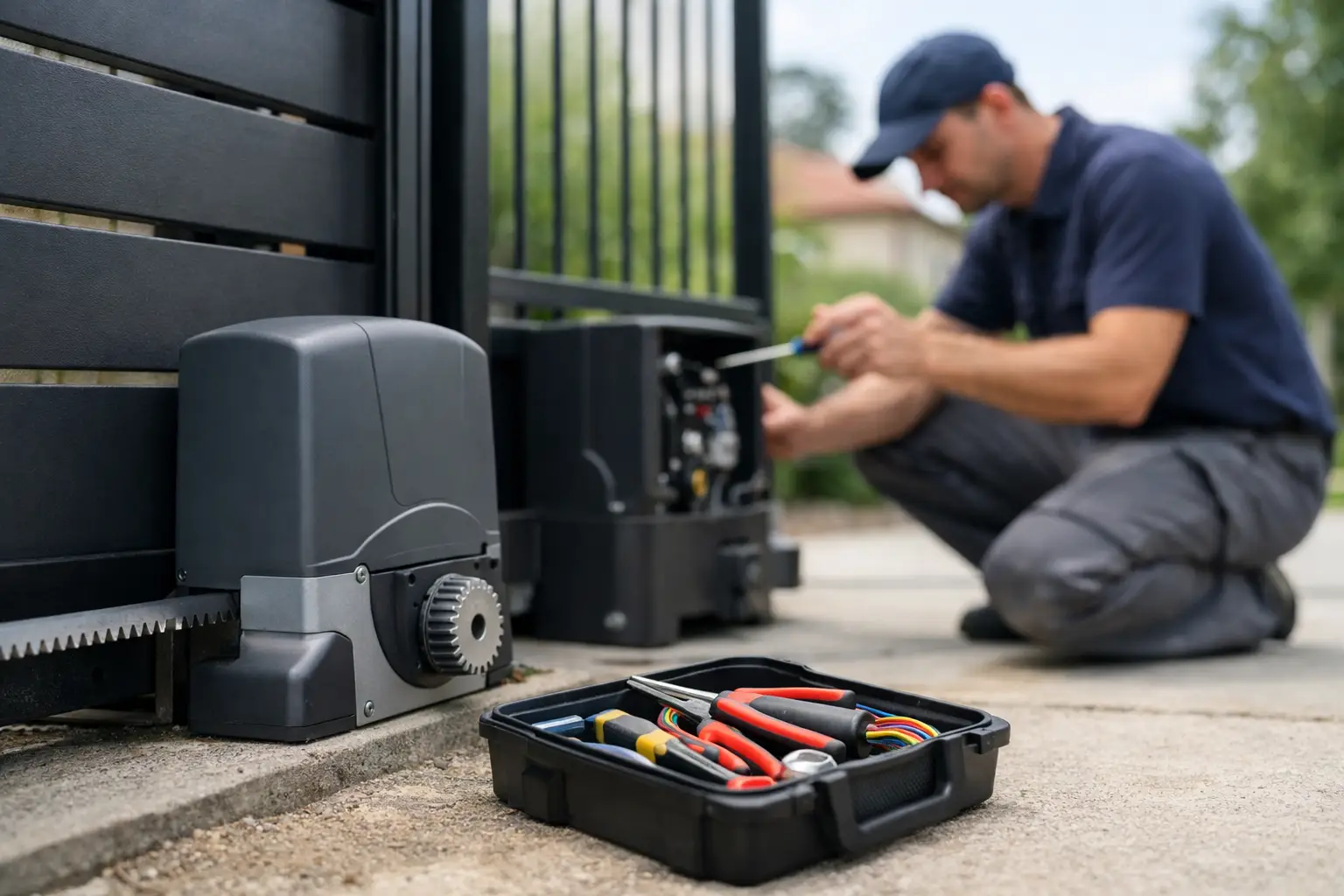
A Mesa automatic gate repair example often starts the same way: you pull into the driveway after a long day, press the remote, and the gate moves halfway before stopping. Maybe it reverses for no clear reason. Maybe the motor hums but the gate does not move at all. Either way, a gate that will not operate correctly is more than an inconvenience. It can leave your home or business exposed, block vehicle access, and create a real safety concern.
The good news is that many automatic gate problems have a clear cause. The key is knowing what you can safely check, what should be left alone, and when a fast repair call can prevent a small issue from turning into a damaged operator or a stuck gate.
A Mesa Automatic Gate Repair Example From Start to Finish
Picture a sliding driveway gate at a Mesa home. The homeowner notices that the gate begins opening normally in the morning but stops about two feet from the fully open position. Pressing the remote again makes it close, but it will not finish its opening cycle. By that afternoon, the problem gets worse. The gate stops immediately and the keypad no longer works reliably.
A situation like this can have several possible causes. The operator may be detecting resistance in the track, the safety sensors may be blocked or out of alignment, the chain could be too loose, or the control board may be receiving inconsistent power. Arizona heat, dust, monsoon moisture, and normal wear all put stress on gate systems over time.
The first step is not replacing parts at random. A qualified gate technician starts by checking the basics: power at the operator, remote and keypad response, safety devices, the gate’s travel path, rollers, hinges, track condition, and the operator’s settings. That inspection narrows down whether the issue is mechanical, electrical, or both.
In this example, the sliding gate’s track had collected packed dirt and small landscape debris near a wheel. The gate was also dragging because one roller had begun to wear unevenly. The operator sensed the added resistance as an obstruction and stopped the gate to protect people, vehicles, and the equipment itself. The technician cleaned the track, corrected the roller issue, checked the chain tension, and tested the safety reverse function several times before leaving.
That repair is a good reminder that the gate motor is not always the real problem. An automatic gate operator has to work much harder when the gate is binding, sagging, rubbing, or moving over a dirty track. Replacing the operator without correcting the resistance would only delay the next breakdown.
Why an Automatic Gate Stops or Reverses
Automatic gates are designed to stop or reverse when they detect something unusual. That feature protects people and property, but it can also activate when a component is worn or misaligned.
A swinging gate may reverse because its hinges are binding, an arm is loose, or the gate has shifted out of alignment. A sliding gate can stop because of damaged rollers, a bent track, a loose chain, or debris in the travel path. Even a gate that looks fine from a distance can have a small issue that adds enough resistance to interrupt the cycle.
Electrical issues are also common. A weak battery backup, damaged wiring, a tripped breaker, corroded connections, or a failing control board can cause inconsistent operation. If the gate works sometimes but not others, the pattern matters. For example, a gate that struggles only during the hottest part of the day may have an overheating operator or a component affected by high temperatures.
Safety equipment deserves close attention as well. Photo eyes, edge sensors, and other entrapment-protection devices must be working correctly. A dirty sensor lens, a misaligned photo eye, or damaged low-voltage wiring can keep the gate from closing or cause it to reverse unexpectedly. These are not parts to bypass just to get the gate moving. Safety devices are there for a reason.
Safe Checks Before You Call for Gate Repair
If your gate has stopped working, begin with a quick visual check from a safe distance. Look for branches, rocks, trash cans, landscaping material, or anything else in the gate’s path. Check whether the operator has power and whether a breaker has tripped. If you use a remote, try a second remote or the keypad to see whether the issue is limited to one access device.
You can also look at the photo eyes, if your system has them. Make sure they are not covered in dust, spider webs, or leaves. Do not force the gate by pushing or pulling it while the operator is engaged. Forcing it can damage the arm, chain, gear, rollers, or operator.
If your gate has a manual release, use it only according to the manufacturer’s instructions and only when it is safe to do so. A heavy gate can move unexpectedly on a slope or when hardware has failed. Keep children, pets, and vehicles away from the opening until the gate has been inspected.
It is time to call a professional if you notice grinding sounds, a burning smell, damaged wiring, a sagging gate, repeated reversing, or an operator that runs without moving the gate. Those symptoms can point to problems that should not be handled as a quick do-it-yourself fix.
What a Professional Repair Visit Should Include
A proper automatic gate repair is more than getting the gate to open once. The goal is to identify why it failed and make sure it can operate safely afterward.
A technician should inspect the gate’s physical movement before adjusting the operator. That includes rollers or hinges, the track, posts, brackets, chain or belt components, and any signs that the gate has shifted. Next comes the operator system: power supply, batteries, limits, force settings, controls, wiring, remote access equipment, and safety devices.
Once the repair is complete, the gate should be cycled repeatedly. It should open fully, close fully, stop where it is supposed to stop, and respond correctly when the safety system is triggered. For homes and small businesses, that testing is what helps avoid the frustrating situation where a gate works during the service visit but fails again later that evening.
At Riggs Rescue AZ, the focus is clear explanations and practical repair options. If a worn roller and track cleaning will solve the issue, you should hear that. If an aging operator is becoming unreliable and replacement makes more financial sense, you should hear that too. Honest guidance means explaining the trade-off instead of pushing a bigger repair than the gate actually needs.
Repair or Replace? It Depends on the Gate’s Condition
Not every gate problem calls for a new operator. A gate with solid structure, good movement, and a single failed component may be a straightforward repair. Replacing a remote receiver, battery, safety sensor, roller, hinge, or gear can restore dependable operation without a major investment.
Replacement becomes more reasonable when repairs are frequent, parts are no longer available, the operator is undersized for the gate, or the system lacks current safety features. Commercial properties may also need an upgrade when the gate is handling more daily cycles than the existing equipment was designed to support.
The condition of the gate itself matters just as much as the operator. A new motor cannot compensate for a gate that is badly rusted, dragging, sagging, or poorly supported. In those cases, correcting the structural problem first protects the investment in the access system.
Preventing the Next Automatic Gate Breakdown
Most gate failures give small warnings before they become urgent. Slower movement, new noises, inconsistent remote response, or a gate that needs several button presses should not be ignored. A quick service check can often catch worn parts before the gate gets stuck open or trapped closed.
For homeowners, keeping the track and gate path clear is one of the simplest habits that helps. For business owners and property managers, routine inspection is especially valuable because a nonworking access gate can affect employees, deliveries, customers, and site security.
Your automatic gate should make entering and leaving your property easier, not add another problem to your day. When it starts acting up, avoid forcing it or disabling safety features. A prompt inspection can protect the gate, the operator, and the people who rely on it every day.

Leave a Reply