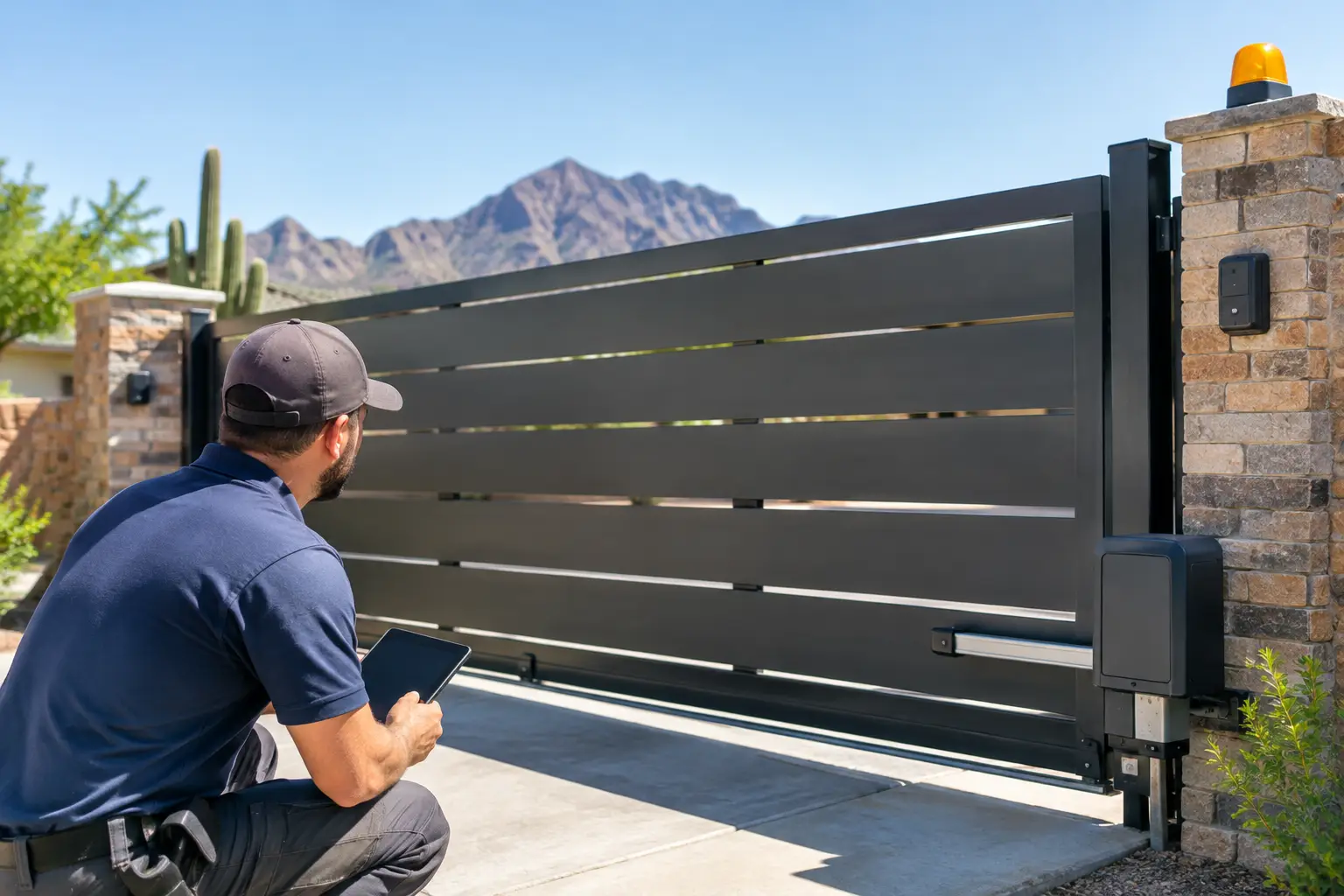
A gate that opens on command can still be unsafe when its sensors are outdated, its closing force is poorly adjusted, or its safety devices no longer communicate with the operator. The best automatic gate safety upgrades protect the people, pets, vehicles, and deliveries moving through your property every day – without making entry a hassle.
For homeowners and business owners, the right upgrade depends on the gate type, how people use the entrance, and the condition of the existing operator. A sliding driveway gate has different risk points than a swinging gate at a small business, for example. The goal is not to add every available device. It is to build a system that detects hazards, stops when it should, and stays dependable in Arizona heat, dust, and monsoon weather.
Best Automatic Gate Safety Upgrades for Safer Entry
Monitored photo eyes
Photo eyes are among the most valuable safety improvements for automatic gates. These sensors create an invisible beam across an opening or travel path. If a person, pet, bicycle, or vehicle breaks that beam while the gate is closing, the operator should stop and reverse.
A working set of photo eyes is especially helpful at residential driveways where children and pets may move unpredictably. For commercial properties, they can help protect employees, customers, and delivery drivers in areas with regular vehicle traffic.
Placement matters as much as the sensor itself. An eye mounted too high may miss a small child or pet. One mounted where direct sun, landscaping, or passing traffic repeatedly interferes with it can cause nuisance reversals. A gate technician can determine the right locations and confirm that the sensors are monitored by the operator rather than simply added as a basic accessory.
Monitored sensing edges
A sensing edge is a pressure-sensitive strip installed along the leading edge of a moving gate or on other pinch-point areas. When the edge contacts an obstruction, it signals the gate operator to stop or reverse. This is a strong layer of protection where a photo-eye beam alone cannot cover every risk.
Sliding gates may need sensing edges on the front edge, rear edge, or both, depending on the layout. Swing gates can benefit from edges where the moving panel approaches a post, wall, fence, or other fixed object. The exact setup is not one-size-fits-all, which is why a site inspection is worth more than a quick guess.
For gates with aging wired edges, a monitored wireless edge can be a practical replacement in certain applications. Wireless equipment reduces cable-routing challenges, but it still needs reliable batteries, correct programming, and regular testing.
Better entrapment protection at pinch points
The space between a gate and a fence, wall, post, or landscaping feature can create an entrapment zone. So can gaps in decorative iron gates or areas around rollers and tracks. These hazards are easy to overlook because the gate may appear to operate normally.
Physical guards, properly designed fencing, and safer gap spacing can reduce access to these dangerous areas. In some cases, the best solution is repositioning hardware or modifying the gate design rather than adding another electronic sensor. A professional should evaluate the entire gate travel path while the gate is moving, not just inspect it while it is parked open.
Updated operator controls and force settings
An automatic gate should reverse when it encounters a real obstruction, but the gate should not rely on force sensing as its only safety feature. If the force setting is too high, the operator may keep pushing longer than it should. If it is too low, the gate may reverse constantly during normal operation.
A properly adjusted operator works with photo eyes and sensing edges, not instead of them. Older gate operators may lack the monitoring capabilities needed to support modern safety devices. When that happens, replacing the operator can be the safer and more cost-effective move over the long term.
This is also a good time to inspect the gate itself. A sagging swing gate, damaged track, worn rollers, or failing hinges can make a safe operator behave unpredictably. Safety upgrades work best when the mechanical parts are in good condition.
Do Not Overlook Pedestrian Safety
Vehicle gates are not pedestrian gates. A driveway gate should never be treated as a casual walk-through entrance, even if family members or employees use it that way. People on foot can enter blind spots, stand in a gate’s path, or become caught near moving hardware.
A separate pedestrian gate with reliable latching and access control is often the safest answer. Clear signage can help, particularly at commercial properties, but signs are not a substitute for physical protection and well-designed access routes.
If a pedestrian must pass near an automatic vehicle gate, consider whether additional photo eyes, guarded hardware, or changes to the walking path are needed. This is particularly relevant for multifamily properties, small offices, and businesses with frequent customer traffic.
Warning Devices That Make Gate Movement Easier to See
Warning lights and audible alarms are simple upgrades that can prevent surprises. A flashing light can alert someone that a gate is about to move or is currently moving. An audible warning can be useful near busy driveways, shared access lanes, and commercial entrances where drivers may be focused on traffic rather than the gate.
These devices are helpful, but they are secondary safety measures. They warn people of motion; they do not detect an obstruction. Use them alongside monitored protection devices and a properly maintained gate system.
For Arizona properties, visibility is also a practical concern. Bright sun can make a small status light hard to notice, while evening traffic can make an unlit entrance harder to navigate. The right warning device should be visible and positioned where approaching drivers and pedestrians can actually see it.
Emergency Release, Backup Power, and Surge Protection
A safe gate must also allow a safe exit when power fails or equipment malfunctions. Every property owner and designated employee should know where the manual release is located and how to use it. The release should be accessible when needed but protected from casual tampering.
Battery backup can keep a gate operating during a power outage, which is valuable for homes and businesses that depend on controlled access. It does not replace a manual release, and it needs periodic checks. A neglected backup battery may fail at the exact moment you need it.
Surge protection is another smart consideration in the East Valley. Electrical surges from storms or utility interruptions can damage operators, access-control equipment, and safety-device connections. Protecting the system can reduce unexpected failures and help preserve the investment you have made in your gate.
Access Control Can Support Safety Too
Keypads, remotes, phone entry systems, and vehicle loops are often viewed as security upgrades, but they can also improve safety when they reduce rushed or improper gate use. A well-placed exit loop lets vehicles leave without requiring a driver to get out or tailgate another vehicle through the gate.
The trade-off is that access equipment must be configured carefully. A poorly located loop may trigger from traffic outside the property. A keypad positioned too close to the gate can leave vehicles sitting in the movement path. Good design considers where drivers wait, turn, and clear the opening after the gate moves.
How Often Should You Test Gate Safety Devices?
A quick visual check each month can catch obvious trouble. Make sure photo eyes are clean and aligned, sensing edges are secure, warning lights operate, and the gate does not scrape, bind, or make new noises. Keep rocks, leaves, trash, and overgrown landscaping out of the gate path.
Test reversal functions according to the operator manufacturer’s instructions, and never use a person, pet, or vehicle as the test object. If the gate fails to stop or reverse, keep it out of automatic service until it has been inspected and repaired.
A professional maintenance visit is a practical way to check force settings, wiring, rollers, hinges, chain or belt condition, limits, safety sensors, and emergency release function together. For properties with heavy daily traffic, more frequent service may make sense.
The safest upgrade is the one that fits your gate, protects its real-world hazards, and is kept in working order. If your gate has unreliable sensors, visible pinch points, or a history of random reversals, a qualified gate technician can help you sort out the right fix with clear options and no surprises.

Leave a Reply