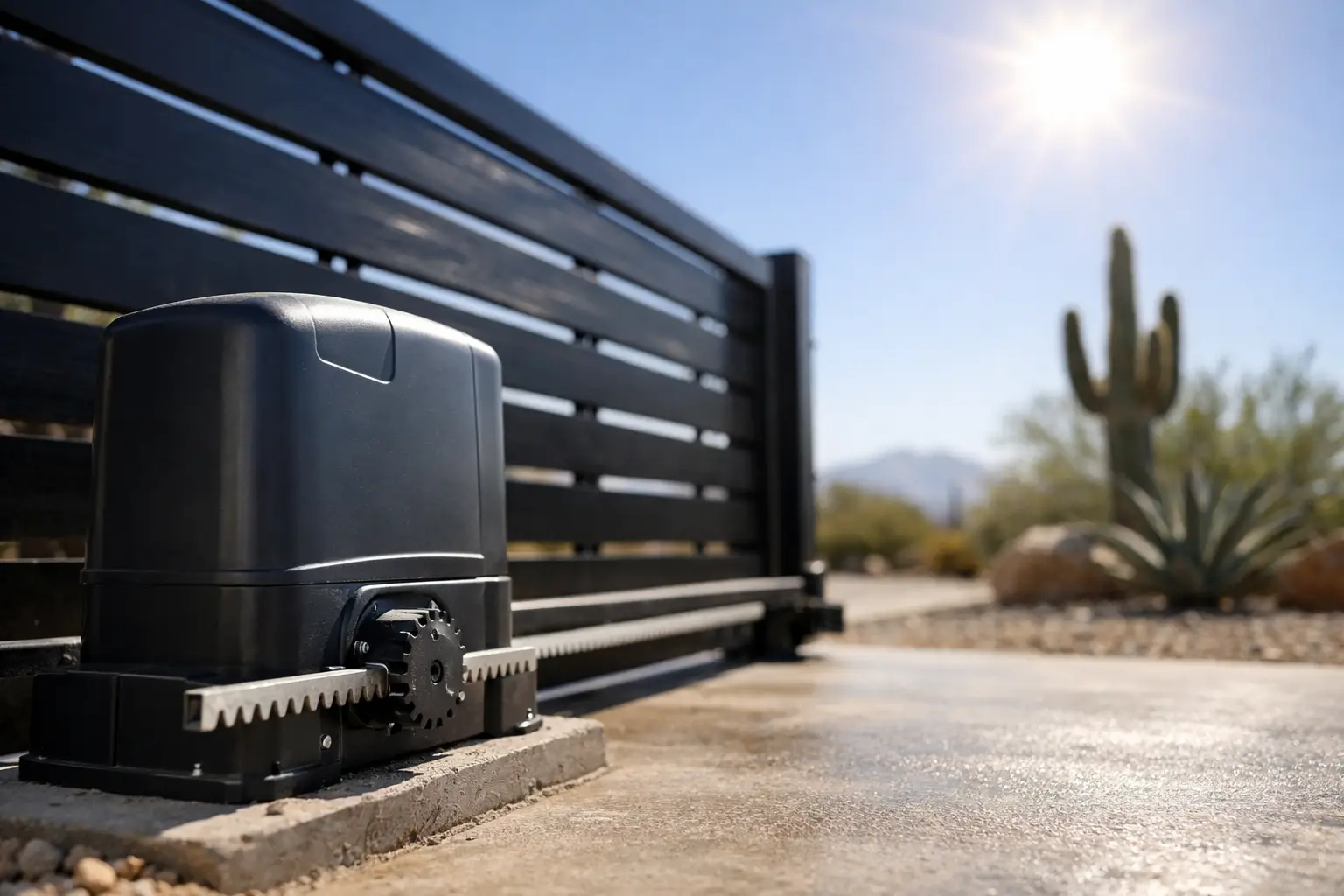
A gate that opens slowly, stops halfway, or needs a second click from the remote is more than an inconvenience when you are trying to leave for work or secure your property at night. Homeowners often ask how long gate motors last after the first signs of trouble appear. The honest answer is that it depends on the motor, the gate, the installation, and how much Arizona heat and daily use the system handles.
Most residential gate motors last about 10 to 15 years. A well-matched, properly maintained operator on a lightly used gate can sometimes serve a property for 15 to 20 years. On the other hand, a motor working hard to move a heavy, misaligned, or frequently used gate may need major repair or replacement in 7 to 10 years.
How Long Gate Motors Last Depends on the Whole System
The term “gate motor” usually refers to the automatic gate operator: the powered unit that moves the gate. But the operator is only one part of the system. Tracks, rollers, hinges, chains, gears, safety sensors, control boards, remotes, batteries, and the gate itself all affect how long it lasts.
Think of it like a vehicle engine. Even a quality engine wears out early if it is forced to pull a heavy load with bad tires and poor alignment. A gate operator faces the same problem when the gate drags, binds, sags, or catches on the ground. The motor has to work longer and draw more power every time it opens and closes.
For a typical single-family home with a swing or sliding driveway gate used a few times each day, 10 to 15 years is a reasonable expectation. For apartment communities, warehouses, storage facilities, or busy commercial properties, the lifespan can be shorter because the operator may cycle dozens or hundreds of times each day. Commercial-grade equipment is designed for heavier duty, but it still needs service to keep up with that workload.
Arizona Heat Can Shorten Motor Life
Gilbert, Mesa, Chandler, and nearby East Valley communities get long stretches of extreme summer heat. That heat affects more than the metal gate. It can put steady stress on the electrical and mechanical parts inside an operator.
Control boards, capacitors, wiring insulation, batteries, and plastic components can all deteriorate faster when exposed to high temperatures. Direct sun also raises the temperature inside an operator housing well above the outdoor air temperature. Dust and monsoon debris can enter vents or moving parts, while sudden rain can expose weak seals, damaged conduit, or corroded connections.
Heat alone does not mean a gate motor will fail early. A properly installed operator with the right enclosure, ventilation, wiring, and surge protection can hold up well. The trouble starts when heat combines with neglected maintenance, an undersized motor, poor drainage, or a gate that is difficult to move by hand.
Battery backup systems deserve special attention in Arizona. Batteries are helpful during a power outage, but they generally wear out much sooner than the gate operator itself. Many gate backup batteries need replacement every two to five years, depending on the battery type, heat exposure, charging system, and how often the system runs on backup power.
What Wears Out a Gate Motor Faster?
Daily cycles matter, but they are not the only issue. A gate that opens four times a day under ideal conditions can outlast a gate that opens twice a day but strains on every cycle.
Common lifespan killers include:
- A gate that drags, sticks, or has worn rollers, hinges, or wheels
- An operator that is undersized for the gate’s weight, length, or wind load
- Power surges, failing electrical connections, or water intrusion
- Lack of lubrication and adjustment on moving gate hardware
- Constant use at a commercial property without a maintenance plan
Sliding gates can develop problems with rollers, track alignment, chain tension, and debris in the travel path. Swing gates may put extra force on hinges, arms, brackets, and underground components. Wooden gates can become heavier over time, while solid metal gates may catch more wind. Each of these conditions changes the workload placed on the motor.
A skilled technician should check whether the gate moves smoothly by hand with the operator disengaged. If it does not, replacing the motor alone may only provide a temporary fix. Correcting the gate’s movement first protects the investment in the new operator.
Signs Your Gate Operator Needs Attention
Gate motors rarely quit without warning. Small changes in speed, sound, and reliability often show up before a complete failure. Addressing them early can mean a straightforward repair instead of an after-hours access problem.
Watch for four common warning signs: the gate moves slower than usual, the motor hums or strains without moving the gate properly, the gate reverses or stops randomly, or it only works intermittently with the remote or keypad. Grinding noises, repeated tripped breakers, a burned smell, or visible damage around the operator should be checked promptly.
Safety issues deserve immediate attention. If photo-eye sensors are misaligned, safety edges are damaged, or the gate closes when it should reverse, stop using the automatic function until the system has been inspected. Automatic gates are heavy, and their safety devices are not optional extras.
Repair or Replace: Which Choice Makes Sense?
A repair is often the right call when the operator is relatively new and the problem is isolated. A failed capacitor, worn gear, damaged remote receiver, faulty limit switch, weak battery, or wiring issue may be repairable at a reasonable cost. Repairs can also make sense when a quality commercial operator has plenty of useful life left.
Replacement becomes more practical when the operator is near or beyond its expected service life, has recurring electrical or control-board failures, or no longer has available replacement parts. It may also be time to replace the unit if the current motor was never properly sized for the gate.
Newer gate operators can offer better safety features, more dependable controls, battery backup options, and app-based access features. Those upgrades can be useful, but they should not be pushed on every repair call. The right choice depends on the condition of the gate, the age of the operator, the cost of the repair, and how much reliability your home or business needs.
For a business with deliveries, employees, tenants, or customers coming through all day, downtime can cost more than a replacement. For a homeowner with a repairable operator and a smooth-running gate, a targeted repair may be the more affordable, sensible option.
Maintenance That Helps Gate Motors Last Longer
A little preventive care can add years to an automatic gate system. Keep the travel path clear of rocks, leaves, branches, and blown-in debris. Do not let landscaping grow into photo eyes, moving arms, or the operator housing. If your gate uses a track, inspect it regularly for buildup and damage.
It also helps to listen to the gate. A quiet, steady movement is usually a good sign. New squeaks, popping, grinding, or a noticeable slowdown are reasons to schedule service before the operator is forced to work harder.
Professional maintenance should include checking gate balance and movement, inspecting rollers or hinges, testing safety devices, examining wiring and controls, verifying limits, and looking for early signs of wear. Lubrication should be done with the correct product and in the right places. Too much grease in the wrong area can attract Arizona dust and create a bigger problem.
Get an Honest Answer Before the Gate Stops Working
If your automatic gate is aging, acting unpredictably, or struggling in the heat, do not wait for it to fail when you need access most. Riggs Rescue AZ can inspect the operator and the gate hardware together, explain what is causing the issue, and give you clear repair or replacement options with no surprises.
A gate motor does not need to be brand-new to be dependable. With the right diagnosis and timely care, you can keep your gate moving safely and avoid turning a small warning sign into a locked-out driveway or disrupted business day.

Leave a Reply